


Christian Identity and the Hegemony of Mammon
4 years ago

Before I was 17 years old I was a good young catholic, I even went to see Jean Paul II in 1984 when he came to my country. I was highly educated in a Jesuit school. Actually, they taught me to never accept an statement without questioning it. So I did, I read my bible looking for answers, met my Lord and inevitably left catholic path.
So as a Latin-American I have a special feeling and love for grassroots Catholics, I have seen their search for faith and I understand their love for their religion. Catholicism is part of culture and grassroots Catholicism helped poor people to survive their masters and poverty. Only their Christ (unfortunately not always the biblical one) gives them hope to keep walking. Many of them have a real relationship with God. So I felt sad when I noticed trough the 90’s that Jean Paul II and his right arm Mr Ratzinger removed from any authority in their church enthusiastic priest with new progressive ideas in Latin America. Priests that read their bibles, believed in Love and the Grace of God. To removed them was a long process that lasted many years. When Jean Paul II died and Mr Ratzinger arrived to the power as pope, all Cardinals in latin America and probably the world belonged to the old catholic orthodox school. The cleaning up was completed, and all priests from Vatican II that had any new progressive view were relocated as simple priests in some forgotten parish in some forgoten town. So you imagine I was not a surprise to see Mr Ratzinger becoming Pope and having all these old orthodoxy interpretation of his church.
Why I rumble all these things? Well somehow I am very very surprised that and intelligent man as Mr Ratzinger (better known today as Benoit XVI) has made such a theological mistake. He just called church “sinner” and “wounded”(see the media)
I won’t debate internal catholic scandals. It is sad what is happening, and it is not new. It has been more than 20 years we have heard about this problems, so one day justice had to cry louder, so it does today.
But that is not the issue I want to talk. Mr Ratzinger has made a weird theological statement. The Bible teaches us that The Church is the Body of Christ and it is the Bride of Christ too. And as the apostolic creed says "it is Holy" because it has been cleaned by blood of the lamb of God. And it goes through history victorious even in tribulations. The Bible will never called the church sinner or wounded, even in rough times, like when Paul wrote to Corinthians, and weird things were happening in that church.
But for Mr Ratzinger his priest are the church! And some of his priest are sinners, therefore the church is sinner. It is embarrassing, but Catholic theology has been trapped in a paradox that contradicts Paul’s writings and their own theology of Church . They just have gotten themselves a holy church that is sinner. Will they drop the word "Holy" in their creed?
If you are an outsider you may wonder, why after 500 years Protestants and Catholics are still separated? Why is even so diffcult to agree and reunify at least in one symbolic ecumenical church?
Well differences can be more difficult to solve than we think.
Oddly enough it is not the protestant dogma of salvation by faith what dived us.Although it is not Vatican theology many Catholics and priest believe that too, neither the Bible is a big difference, we have the same Bible, and they have lovely translations. We both believe Christ is the Son of God who came for our sins, ..well they have their saints… So what is this the real difference?
What really differentiates us is; the understanding of what The Church is, and the How the Grace of God is send by God.
For Protestants (all movements); Church is the community of believers that have been touched by the Grace united by the Holy Spirit. God gives his grace directly to each believer and all believers are priests, so all believers are equals before the Grace. A minister and simple believer are just equals, sinners saved by his Grace. For us God in Jesus, delivers his Grace as he wishes, and we only announce the good news.
For Catholics; Church is the community of believers united by the Holy Spirit which allows the church to hold and delivers the Grace of God. But the Holy Spirit does not act the same in all believer. Not all believers can deliver the Grace of God, only those that have received priesthood. And Priesthood can only be delivered by the Pope who is directly chosen by the Holy Spirit to validate the elite of priests the Holy Spirits choses among believers . So there is an elite chosen by the Holy Spirit that delivers the Grace of God through the seven sacraments. Grace can only be delivered through these seven sacraments. Each on of this 7 sacraments are concrete manifestations of the Grace of God. So the Catholic Church is based on this elite that has been named by God through the Pope to deliver these 7 sacraments (so the Grace of God). You are free to believe the way you want, (salvation by faith if you want) But you cannot doubt neither question: the 7 sacraments (the manifestation of the Grace of God) , the people that delivers them (the priests) and the one that has been chosen to lead this elite (The Pope)
So Priesthood is understood for them as eternal and mystical reality, a superior state of grace more important that the man who is the priest. Why? Because the sin of the priest should not affect the Grace of God delivered in a sacrament. So even if the man is the worst sinner, he is still a priest that holds and delivers the Grace of God
. So the church must cover the sinner to protect the mystery of his priesthood which is bigger than the man that holds it. So God will continue to deliver His Grace in the seven sacraments through the priesthood of this man, even if this man is the worst sinner, through the years Catholic church felt necessary to protect the sinner not because the man but because his priesthood which overcomes the man, and finally is more important than the man, because priesthood is the fundamental on which catholic church is built..
For Protestants, if the believer sins (or a minster, who is just a man, we do not have elite priesthood, we are all priests ) then the man is a sinner. If his sin is a crime against society, he is excluded from the community until he repents and he should pay his duties to the law. So even if the Church is sad, the sin of this man does not transform the community in "sinner". Church is holy because the Lord has cleaned it, man is a sinner and individually responsible of his own sins. The protestant believer does not deliver the Grace of God, He proclaims it!!. It is up to God to deliver it in Jesus name and according to his will.
For Catholics, their priest have sin, the church in order to protect priesthood has historically covered their sins. Now they feel guilty, they realize it was a sin; so priesthood is in sin, so Mr Ratzinger concludes the church is sinner. They have wounded their believers, so Church is sinner and wounded….It seems to me he is caught in an illogical logic, and completely forgot that Church is the future wife of Christ and Christ himself is his head. It does not belong to priests, pastors. or who ever. It belongs to Him!!!. I hope he has not forgotten who Christ is and that He himself will come to judge us too.
I am sorry Mr Ratzinger some of your priest may be sinners, and criminals, and they must pay their crimes, but the real Church of Christ is not sinner and many of your grassroots Catholics have been touched and will be touched by the Grace of God. Wake up, call your people to real conversion, call from the exile all these good priests who read their bibles and wanted to change your church and with grassroots catholic that only have Jesus as consolation be for once part of the Real Spiritual Universal and Invisible Church of Christ, which is Holy and Victorious by His Irresistible Grace.

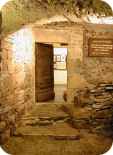
She was only 18 years old when she was arrested and imprisoned in the Royal Fortress “Aigues-Mortes” at the Mediterranean Sea shores, more precisely in the Tower of Constance (see picture) This fortress was built in the XIII century to affirm French Royal Power and to protect the kingdom against invasions. The main town (a medieval village) was inside the Fortress and it is called Aigues-Mortes and gave the Fortress its name. This town still exists nowadays and is part of southern cotemporary French society. Not Far (2 hours) from the French Riviera and 1 hour from Marseille a 6 million people city.

With the revocation of the Edict of Nantes in 1685 protestant worship was forbidden in France. Those who continued were arrested. So that was the fate of Durand Family. One by one they were arrested because they organized unlawful secret home services. Marie’s mother was the first one arrested when Marie was only 4 years old, she would never saw her mother again.

Later his brother, Pierre Durand became a pastor like his father and broke the law too organizing secret home services, he was unsuccessfully hunted by local authorities. So the authorities decided to take revenge again on her family. His Father Etienne Durand was imprisoned in 1728. Looking for protection and following her father advise married at an early age she married to Matthieu Serres, his father friend. In 1730 Matthieu Serres was imprisoned too. Finally his brother Pierre was caught and hanged in April 22, 1732, when he was thirty years old
Following this,Marie Durand was imprisoned with many other women who would refused to give up their beliefs. Authorities only asked them to knee in front of an image in order to be relief. Yet they did not.
The captivity of Mary Durand lasted 38 years. Imprisoned with other Women of all ages and all conditions, she lived in poverty and restricted conditions.
It has been found in a room on the tower stone walls, carved the word "RESISTER" (To Resist) Tradition says it was Maria's cells. So she wrote it to encourage herself and gear her companions not to give up. Whether she carved it or not. It is a symbol of these women spirit. Maria as most of these women was a restless prisoner, refusing to recant her faith, exhorting his companions to be strong and writing numerous letters, petitions asking for justice, or letters of thanks to those who sent relief prisoners; letters to Pastors, friends and members of her family.
In January 1767, Prince Beauvau, governor of Languedoc, visit the Tower, he was appalled and shocked by the plight of women still imprisoned and released them.A minister of King Louis XV's attempted to oppose it but after more than 80 years of religious hate the country was tired and ashamed. Fourteen women were released, one of them, Marie Robert, had been imprisoned 41 years.
Marie Durand was released April 14, 1768 and it was not until December 26, 1768 for the last two prisoners are released. Marie Durand died at his birthplace at Bouchet-of-Pranles in 1776.
Protestant History has men and women that should inspired us with their strength as first Christians did, as many do today in persecuted churches. From our comfortable sites and PC and smart phones, and blogs etc etc Let's not forget them.

Samuel Escobar, is native of Peru (my country land) and he is a leading Latin American theologian.
Part of the same generation of Rene Padilla, he was part of the first young generation touched by John A Mackay teachings. I had the chance to participate at some of his conferances when I was young Chrsitian student back in Peru.
He is one of my references on my theology thinking structure. He was one of the key participants in the International Congress on World Evangelization at Lausanne, Switzerland, in 1974. I think is currently serves as professor of missiology at Palmer Theological Seminary in Wynnewood, Pennsylvania, and as theological consultant for the Board of International Ministries in Valencia, Spain. He is also president of the United Bible Societies and past president of the International Fellowship of Evangelical Students.
Here he give us a little inside on Latin Amercan Churches. I find his thought very accurate and and helps us to understand Latin American Christian way of living faith.

After only 4 years in Canada, and already 14 years in Europe some North American Christian traditions are still strong to me. Although Candles services are originally from Europe, they are almost forgotten in France.
I still remember with emotion the lovely Candle services at the Wolfville Baptiste Church, the town church that hosted me during my 4 years in Canada. . The main goal of candle services, to stop and think about the true meaning of Christmas, was reached beautifully each 24th of December. As a forerigner this is an unforgottable memory for me.I am a reformed hearted fellow but I really enjoyed my 4 Baptists years in Canada. I miss that lovely church I hope I will be able to visite them again one day.
So 14 years later I am an elder in a little and humble Evangelical Reformed local church in the south of Paris.
Unlike Wolfville in NS Canada which is a 4000 people lovely town, Paris and its suburbs are 20 million people!!. In Wolfville the 24th of December we smiled people warmly at the streets, most of them would already had finished a day before their shopping, and a few of them who hadn't yet, they would finished it way before 5h00 pm, at 5h30 pm every thing was closed and every body went home, so we took hot chocolate or a cappuchino and enjoyed the first snow flakes. At that season Canadians don't call it "snow", they call it "White Christmas." So we just enjoyed the season feelings and prepared ourselves for a lovely Candle Services at 7h00 pm.
Paris the 24th of December is just awful, and up 50% or probably 70% of Parisians are still buying their presents until midnight. Shops are crowded, and streets are jammed. There is a little probability of snow, yet it is very cold outside, moisty cold. People are stressed and very distracted, and it goes like that until probably 8h00 pm or later. Oddly enough Paris had snow this year, but a week early, and the 24th it had already melted and we had only plain cold rain :-(
So a candle service in Paris can have too a deep meaning; to stop our rushness and to think about the true meaning of Christmas. So I started candle services traditions at my church almost 7 years ago, and although we do not follow the same North American style, year after year a small crowd of our church manages to challenge trafique jams, crowed streets and last minute shopping and come at 7h00 to sing, pray and praise the Lord and to remember the true mining of Christmas.
So I had the Christmas Eve mediation privilege and again we read Luke history of nativity for a thousand time, yet a thousand time later three phrases will never ever stop to amaze me.
Luke 2
· (7)…. and wrapped him in swaddling clothes,....
Like any child… like any human child…. God almighty became flesh and as any baby He was wrapped in swaddling clothes. How can we sometimes forguet the awe of Christmas?
· (7)…….. and laid him in a manger; because there was no room for them in the inn
There was no room for him!!!! I wonder if now days He has room in our Christmas, in our life, in our schedules, in our logics, in our way of being Christians!!
· (15) the shepherds said one to another, Let us now go even unto Bethlehem, and see this thing which is come to pass, which the Lord hath made known unto us
The good news was addressed first to simple people, forgotten and outcasted people. Shepards were indeed the lowest class popiluation of their time, poor, ignorants, illiterates, impure and unworthy to be part religious life of their time. Indeed forgotten people of their time doing and unworthy job. Would I be part of these people at the time? would I be part of the first people that God had choosen to deliver the first good news? and if so I wonder if I had probably missed the whole thing stuck in traffic jam!!
I love buying presents and I love giving them. I get caught in my feelings when my kid opens his presents and loves them, I love my huge natural Christmas tree that I buy each year since my Canadian days between 2m and 3 m) I am proud of all the Christmas lights I set up at home. I do love all these things... Yet I should never forget these three messages that Luke story tells us of the fist Christmas . Otherwise, I will just miss the whole point just as if I would spent my whole Christmas in a Parisian traffic jam. Lots of light, lots of noise... even lots of beautiful things to see outside in the street, yet a stressful, useless and meaningless waste of time.

John Mackay may not be a common name for the English world today and he is a theologian almost unknown and forgotten in this side of the Occidental world.
Indeed, he is not an intelectual who is studied side to side to Karl Barth, Paul Tillich or Abraham Kuyper. Yet his thoughts have shaped a generation and his influence and thinking are still revolutioning churchs theologies.
Contemporary Emerging Churches use Mission Integral theology as one of its references. Mission Integral is a theology developed by third world evangelical theologians who search to understand better the message of Jesus while struggling with political and criminal violence and poverty.
Mission Integral Theology is not an emerging church product; it had and it has been influencing it.
The Paradox is that Mission Integral has its origin in the old Calvinist reformed theology, and in a humble calvinst unknow theologian. Mission integral as we know it today was developed by a Presbyterian minister who lived in the first half of 2Oth Century . “Mr John A Mackay”. He believed that announcing the kingdom coming had strong implications on our daily social interaction. And it was not reduced to some moral values (not do this, not to do that, not to be like this, not to be like that).
Samuel Escobar, Rene Padilla, and other young folks of the following Latin American generation had all of them something in common. They all were deeply influenced by this sympathetic and brilliant Scottish fellow who arrived to Latin America (First to Peru) in the late 30's Mr John A. Mackay. He was almost Thirty years old when he arrived to Peru.
He graduated from the University of Aberdeen with First Class Honors in Philosophy and later he ventured across the ocean to Princeton Theological Seminary.
Returning to Europe the First War caught him and he went to Spain before the Spanish revolution. He was very intrigued by the Spanish culture and in particularly of a Spanish Poet Miguel de Unamuno, the Spanish existentialist who, before many others, had discovered and written about Kierkegaard. It was the beginning of a love affair with the Hispanic culture to which he would be devoted throughout his whole life.
In Peru he and his wife founded a Protestant school, now known as the “Colegio San Andres”.
His thoughts, his influence over Political leaders, his philosophy challenged traditional catholique elitist Latin America Spanish structures. John Mackay was quickly indentified as a voice that would challenge establishment from a protestant christian point of view.
John Mackay was invited to occupy the chair of Philosophy in the National University of San Marcos. The Oldest University in South America, founded in 1551 by the Spanish and symbol old Intellectual Elites
So he was the first Protestant to be appointed to such an academic position, and probably the only one until today. In this reknowned university, later he was honored by an award of the "Palmas Magisteriales" by the Peruvian government for John Mackay's contribution to education.
Under special assignment with the South American Federation of the YMCA, he began to lecture and write first in Uruguay and then in Mexico. He was appointed a member of the Board of Foreign Missions of the Presbyterian Church with general oversight of Latin America and Africa.
John Mackay was called in 1936 to the presidency of Princeton Seminary, where he served for twenty-three years not only as President, but as Professor of Ecumenics, the first such designated chair in an American seminary. It was a time of theological crises, Division between liberals, traditionalist, reformed, evangelical etc etc
John Mackay managed the situation with passion for the gospel, deep belief on the mission and deep understanding and respect for each reality he established an environment of orthodox openness and dialogue
His long and distinguished career was still long and distinguished by:
Head of the Commission on the Universal Church and the World of Nations at the Oxford Conference in 1937,
· Member of the Central, Committee of the World Council of Churches (1948-1954)
· President of the American Association of Theological Schools (1945-1950)
· Chairman of the International Missionary Council (1947-1958),
· President of the World Alliance of Reformed Churches (1954-1959).
· Moderator of the General Assembly of the Presbyterian Church in the USA in 1953.
After his retirement from Princeton, he taught at the American University in Washington as Adjunct Professor of Hispanic Thought.
Latin America and Hispanic culture were his passions All his assignment on the international
scene were remarkably well accomplished. He lived through the second war and the cold war Time.
A Young Latin American generation growed up reading his books, listening his lectures. He challenged these young Intellectual Christian to make Theology on the road on their own and not repeat old ways from the balcony.
He would encourage them on a very Kierkegaarian way to embrace the paradox. To understand their cultural past, to live their present to project themselves to the future Kingdom coming " "The End and the Beginning," "The Way to Tomorrow Leads Through Yesterday."To fight with the idealism of Don Quixote but not being as naive as him and to rebuilt its own reality like Robinson Crusoe, with out remaining a Robinson Cruseoe ", "to take the lead, " not to conform themselves to the present time, but to seek the Kingdom of God.
He published thirteen books, three of which he wrote in Spanish. In 1944, he founded and edited several reviews and wrote letter accusing social issue like markarturisme (see d "A Letter to Presbyterians,)" calling for reasonable reflection.
In the same vein, he repeatedly advocated open dialogue and summit meetings of political leaders for China, Russia, and the troubled areas of Latin America. For him there was no conflict between proclaiming the kingdom coming and looking for peace among men. For him to search peace on earth was a prophetic announcement of the Kingdom Coming. If Americans are still discussing the good or the evil of social gospel, and some of them are discovering for good or bad emerging churches, Latin Americans Chrstians learned long time ago from John Mackay that the Mission was integral, teh Gospel was globale, to preach the gospel was to announce now the Kingdom coming and that was more than words but concrete actions too.
Coming out of a small and very conservative Scottish Presbyterian church, John Mackay became a world-recognized spiritual ambassador. And the father of Latin American Mission Integral protestant thought.

Why am I telling you all this? Because through out time U2 music has given me companionship on my pilgrims progress. I discovered quite late "The Joshua Three."in 1993 It was my first year in Canada when I finally started to speak and understand a fair English. It was a major discovery on my Christian life. There it was this rock band that wrote about life, faith and Jesus without complex and using a non orthodox Christian language. I loved it!!! I was 22 years old and "I still haven't found " became my prayer. I was already a deeply engaged Christian, I knew Jesus died for me, I knew He had a plan for me, I knew the kingdom will come and all the colors will bleed into one. Yet I was still running, I still hadn't found what I was looking for. These and other songs inspired me through my Christian life full of struggles, contradictions doubts, love, hanger, passion, falls etc.
I have followed each U2 album and I have almost all his albums at home. I like all of them although I do not like all songs.
Many Christians left U2 after Achtum Baby and criticize very much the two techno-Pop albums; "Zoorope" and "Pop". Yet I find in them a smart and a very elegant critique of Post Modern society . If you have these albums you will notice that each one tells a story. They all start with a first song that sets the mood, the following ones evolve in this mood and aim a final song which set a conclusion and a paradox.
So Achtum Baby will start with ZOOstation, where U2 sings a Hymn to human nihilistic optimism " I'm ready!! Ready for the crash! I'm ready… " The album continues with wonderful and brilliant songs that explore nihilistic happyness and goes from happy and ecstatic moods to sad and depressive feelings full of contradictions and paradox. It ends with a confession of human powerless condition "love is blidness I dont wanna see"
Something similar happens in the other two albums who moved from a classic rock style to a electro techno pop rock style. They follow the same pattern filled of contradictions and paradoxes. Not easy to realize at first sight yet spiritual message is evident for bible readers.
Some times I wond er if "Zooropa "and "Pop" were written only for Christians who have really spent time reading and understanding their Bibles. When deconstructing these albums we find biblical truth everywhere.
The world tours that presented these albums where amazing too. Bono performed and showed how evil was rooted in humanity and in post-modern society."Watch more TV!!! Bono would cry in scene while lighted posters would announce "there is no truth" . Nihilistic cyber postmodern society was represented and performed brilliantly by Bono .
"Uncertainty is a guiding star" says one of Bono songs;… and
I feel numb
Don’t protest
Don’t guess
Don’t bless
Don’t rest
Don’t act
Detract
would answer the Edge song. U2 seemed to ask; "You want post modern relativism?" and his character "Macphisto" and the "Fly"would joyfully answer "..well , just have it baby !!!!!"
Again last songs will hide the answer to absolute relativity .
Zooropa album describes an absolute relative world, everything is nothing, and nothing is for sure. The only truth is that there is no one, and even this is not true. So the first song "Zooropa" starts
(what do you want?)
(what do you want?)
Zooropa...vorsprung durch technik (a step ahead through technology)
Zooropa...be all that you can be
Be a winner
After 9 songs of a pessimistic optimism, when every thing seem so irrelevant and so meaningless, the last song rises a voice of hope. Our good old Johnny Cash (his soul rest in peace) is the Wanderer, a cowboy who wanders on an apocalyptic post nuclear war city sings:
I went out walking
With a bible and a gun
The word of God lay heavy on my heart
I was sure I was the one
Now Jesus, don't you wait up I'll be home soon
In the middle of absolute relativity one voice rises, a very human voice, with the absolute certainty his faith gives him !!
5 years later an even more psicodelic electronic and awesome album "Pop"; U2 seems to surrender to a virtual and relative existence in a society that promises us to keep us all happy!!…. Yet the last song calls us back to reallity "wake up dead man"!!!….. "Jesus Jesus help me I'm alone in this world and Fxxx up world it is"
You see U2 are not prophets, neither tele-évangelists, nor a "happy happy joy joy" Christian group. They are contemporary post modern poets who happen to have a strong faith in Jesus! and they sing what they see, what they feel, what they fear and what they hope, what they pray. And if you are careful enough to read and understand their lyrics you will notice that they know more Bible than you may think.
So before accepting cheap "trashing U2", stop and spend some time to analyse and think for yourself.
Who may have ears to listen.....just listen baby!!!
Magnificent
I was born
I was born to be with you
In this space and time
After that and ever after I haven't had a clue
Only to break rhyme
This foolishness can leave a heart black and blue
Only love, only love can leave such a mark
But only love, only love can heal such a scar
I was born
I was born to sing for you
I didn't have a choice but to lift you up
And sing whatever song you wanted me to
I give you back my voice
From the womb my first cry, it was a joyful noise
Only love, only love can leave such a mark
But only love, only love can heal such a scar
Justified till we die, you and I will magnify
The Magnificent
Magnificent
Only love, only love can leave such a mark
But only love, only love unites our hearts
Justified till we die, you and I will magnify
The Magnificent
Magnificent
Magnificent
Romans 8:29-31 (King James Version)
29For whom he did foreknow, he also did predestinate to be conformed to the image of his Son, that he might be the firstborn among many brethren.
30Moreover whom he did predestinate, them he also called: and whom he called, them he also justified: and whom he justified, them he also glorified.
31What shall we then say to these things? If God be for us, who can be against us?
 ( FYI this is the 2nd part of one of my sermons, first part here...)
"La déconstruction est une méthode, voire une école, de la philosophie contemporaine. etc etc ect "
At first, no association at all with the Post Modern school. (Neither the English version does) Later, it says that Heidegger uses it and only at the end it says that it is Derrida who systematizes it. Yet it does explain that "deconstruction" was associated to Post Modernism in US as well as the British Analytic Philosophy.
".... obtint une grande notoriété aux États-Unis, où il est assimilé à la philosophie postmoderne,"
Otherwise the French article does not associates it at all to French main philosophies, it only fills hardly three pages and it gives very few references. Yet the English wikipedia article, an impressive and complete essay, fills almost 20 pages and gives us so many references.
Post Modern culture and deconstruction are not part of French life, and even well educated French scholars ignore it or understated it in a different way as The English cultures do.
For example the Woody Allen Film "Deconstructing Harry" was translated in French "Harry dans tous ses états" something like "Harry in all his moods" so it could make sense to French auditors. Woddy Allen is loved and admired in France, but "deconstruction"... well it is just ignored.
So when I say that I am Post Modern Protestant in Paris, it may not mean what you think it means, or perhaps it does. You better deconstruct it.
For another similar experience read here
 is a Doctor on Martyrdom and a teachear of Christian Doctrine at Moore College, all the way in Sideny Australia. He has another clever article on Jean Calvin too. Have a look
 The DESERT MUSEUM brings to life the Huguenot past and the history of the Camisards.
In the history of French Protestantism, the expression Desert defines the period of time between the Revocation of the Edict of Nantes (1685) and the French Revolution (1789).
Deprived of freedom of worship, far from the cities, hidden in isolated areas, deserts (in the wilderness, forests, caves, or gullies…), where the Protestants in France (in the Cevennes, but also in Haut-Languedoc, in Poitou, Dauphiné, Vivarais…) were obligated to live out their faith in hiding.
The word Desert also had a biblical sense for them, the 40 years the Hebrew people of Exodus wandered in the desert, a place of tribulations, temptations and despair, but also where they would hear the word of the Lord.
This chapter of history touches all of France, but specifically the Languedoc region and the Cevennes, where Protestantism was largely established at the beginning of the XVIth century.
 The ‘Desert’ period (1685-1789), from the Revocation of the Edict of Nantes to the French Revolution.
The Camisards war
Persecutions and resistance.
The clandestine life.
The long road to freedom of conscience achieved at the French Revolution.
Through fifteen rooms, the Desert Museum presents the following :
Antique furniture and domestic objects from the Cevennes : costumes from the era, a fully equipped authentic XVIIIth century kitchen, products that are grown and fabricated in the region.
A reconstitution of a family evening in the Cevennes.
Original weapons and hand-drawn maps from the Camisards war.
Hiding places for hunted men and forbidden books.
Authentic documents, manuscripts and prints ; official letters and decrees from the royal powers.
Clandestine pulpits, communion cups, birth and marriage certificates.
An impressive collection of Bibles and Psalters.
A large collection of paintings and prints.
This information is taken directly from its web site

 Anthony Smith forme Charlotte, N.C. wrotte this article on his blogs "musing of a postmodern negro"
to Contact him:
postmodernegro@gmail.com

About 8 years ago I started reading about the whole post-modern thing. A friend had given me a copy of Middleton and Walsh's, truth is stranger than it used to be. And I started down the rabbit hole... I also found on my shelves Thomas C. Oden's, two worlds, notes on the death of modernity in america and russia. It's a pretty good read though it looks like it's out of print...
Anyway I got all excited when I realized that I was living in the country that gave birth to a lot of postmodern thought... So I formulated a hypothesis: France would be a great place to test out the ideas of the post-modern, now emerging church, crowd's ideas. That was a faux piste as we say in French and ultimately a dead-end.
I got a first indication of this in the fall of 2001. I was invited to speak at a coupl of church weekends about the church in relation to the world today. I was planning on talking about the pre-modern/modern/post-modern transistions and the impact that has had on the way we do church. Then finishing up with what is postmodernity.
Once I got through my material my audience gave out a collective yawn. Now there was certainly a bit of my own inadequacies and inexperience that played into their boredom but it went much deeper.
Their "so-what" reaction is indicative of a lot what I've seen in France. They have a sort of intellectual detachment in relation to this kind of stuff. The understand it but aren't too bothered to go over the past and do sort of autopsy. They are general more concerned with what needs to happen today, not what happen in the past or what's going to happen in the future. They live in the moment. The "No" vote is a good indication of this. The no wasn't about what the European Union had done to this point or what it would do. It was about a lot of disatisfaction with the way things are today and the present government.
What I didn't know then is the truth that the American expression of post-modern/emerging church talk is dripping with the American cultural identity. And while France has a huge intellectual heritage in this matter what's happening on the ground is very different.
When you think about it this all very normal.
So if you come to France you looking for the "emerging church" thinking it'll look like something you've already seen you'll be looking for awhile.

 Posts
All Comments
Posts
All Comments


