Sunday, February 1

The Museum of Protestants History .

I become a Protestant when I was still in South America (Peru). It has been 18 years walking this path. Coming from the Americas sometimes we feel as if faith started with us. Being in France has given me a sense of History. I have discoverd my roots and I am always in admiration of these men that changed history and struggled so we can live freely our faiths today.

If you come to France make sure you take your time to go to the South (sorry, not the Frecnh Riviera, but the Cevennes) and visit The DESERT MUSEUM. The Cévennes is a southern French region , I think 700 km from Paris, with a rich history of protestantism. Most of Historical French Reformed Evangelical Churchs are based in these regions (and in the south east of this region.
The DESERT MUSEUM brings to life the Huguenot past and the history of the Camisards.

Why "The Desert"?

In the history of French Protestantism, the expression Desert defines the period of time between the Revocation of the Edict of Nantes (1685) and the French Revolution (1789).

Deprived of freedom of worship, far from the cities, hidden in isolated areas, deserts (in the wilderness, forests, caves, or gullies…), where the Protestants in France (in the Cevennes, but also in Haut-Languedoc, in Poitou, Dauphiné, Vivarais…) were obligated to live out their faith in hiding.

The word Desert also had a biblical sense for them, the 40 years the Hebrew people of Exodus wandered in the desert, a place of tribulations, temptations and despair, but also where they would hear the word of the Lord.

This chapter of history touches all of France, but specifically the Languedoc region and the Cevennes, where Protestantism was largely established at the beginning of the XVIth century.
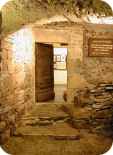
Entrée du Musée du Désert

The Museum Specifically :

- The ‘Desert’ period (1685-1789), from the Revocation of the Edict of Nantes to the French Revolution.

- The Camisards war

- Persecutions and resistance.

- The clandestine life.

- The long road to freedom of conscience achieved at the French Revolution.

It also intends to bear testimony to Protestant faithfulness.

Through fifteen rooms, the Desert Museum presents the following :

- Antique furniture and domestic objects from the Cevennes : costumes from the era, a fully equipped authentic XVIIIth century kitchen, products that are grown and fabricated in the region.

- A reconstitution of a family evening in the Cevennes.

- Original weapons and hand-drawn maps from the Camisards war.

- Hiding places for hunted men and forbidden books.

- Authentic documents, manuscripts and prints ; official letters and decrees from the royal powers.

- Clandestine pulpits, communion cups, birth and marriage certificates.

- An impressive collection of Bibles and Psalters.

- A large collection of paintings and prints.

This information is taken directly from its web site

Monday, January 26

A Ten Sleepy Virgins Story (part I)

The 30th of November 2008 was the first Sunday of Advent and I had the privilege to preach at my local church. I used a simple method of inductive deconstruction on my Bible analisys that I hope you may find useful…
I will post here a simplified version of my sermon in three parts but you have the complete French version at my Church site here


The word "Advent" comes from the Latin Adventus, "the comming". Today, and that is since the VI century, The Advent has become synonymous of preparations for Christmas celebrations “the coming of Jesus Child”. Yet the term "coming/advent” remains deliberately ambiguous.


This morning I will use the parable of the ten virgins, because I want to rediscover with you the spirit of Advent, the preparation for the coming of our Lord in the same spirit of our fathers of the early church.
I will use a simple Bible study methodologyto re-read this parable, I call it, in a very colourful way: "the three-dimensional approach" because it allows us to approach the Word of God from three different perspectives:

a). What I understand at my first reading? What is the message that I find, and what I do, and I do not understand?


b). What the people who heard these words understood at the time?


c). What God really wants me/us/you to understand today?


a) - What I understand ...
The parable of the Ten Virgins always has challenged me throughout my life. Why 5 foolish and 5 wises? Why? Where am I in this parable? What is the real difference between the wise and the foolish? After all, the 10 virgins were all in a waiting mode, aren’t they? Am I on a waiting mode? Am I Wise? Or foolish?
Even more, I always found hard the response of the bridegroom: "I do not know you." And I am stunned with the wise virgins response to the demand for oil of their fellow foolish virgins "rather go to those who sell and buy-in for you”’. It is hard not to feel a kind of sadness for the foolish virgins and even fear ... and if we were one of the foolish virgins?

The traditional interpretation of this parable is based on the spiritualisation of the oil and the lamp. The oil is associated to the "Holy Spirit", the wise virgins keep “extra oil”. When the groom arrives only those who still have oil, so "The Holy Spirit", and kept their lights on are accepted at the wedding.

Therefore: the moral of this story would be: “keep your lights on!, Be always filled with the Holy Spirit”

But the main problem of this “beautiful interpretation” is that even if it is very spiritual, and somehow reassuring, it leaves many questions unanswered, and even worst, it opens up new questions!

1. If the oil runs out of foolish virgins. Can we say that it is possible that the Holy Spirit once given it may run out later?Can the Holy Spiriy be used it up?

2. The wise virgins had brought an extra ration of oil ... so the parable not only opens the door to a concept of different levels of Holy Spirit. But also to the idea that some Christians may have a ration of the Holy Spirit, that is so low and insufficient to qualify them to the Kingdom of God .

3. If the oil is the Holy Spirit, why the response of the wise virgins is "rather go to those who sell and buy-in for you?” Why they do not say: "go and ask the Groom before He arrives!!”

4. If the 5 wise virgins had an extra ration of oil, therefore the Holy Spirit, why do they fall asleep too? Is falling asleep actually a fault?

5. If the groom had arrived some hours earlier, the foolish would still have had the Holy Spirit. Then they would be accepted at the wedding and they would no longer be considered foolish. So it is the delay of the groom who condemned them! (is this Biblical?)

And there are still many other question that the parable opens that remain unanswered:

1. Who are these ten virgins? Will they marry the groom? Is this an openness to polygamy?

2. Jesus begins the parable with the sentence: "Then the kingdom of heaven is like..." What or who is the Kingdom of God in this parable?, The wedding? The coming of the groom? The virgins? The wise and the foolish?

3. Why do they fall asleep? What difference makes that they are asleep or awake? After all, even awake, given the groom's delay, the follish will not be ready because they do not have enough oil.

4. Why are they called there foolish? Why this name? Why "Foolish"?
lets see the

b)What the people who heard these words understood at the time?

............ to be continue

Wednesday, January 21

A prayer was answerd!!!

As most of the world, I spent part of my day watching Obama on TV and reading news on him. I am cought on the emotion and going back and forward some christian blogs posts in him I crossed this article.
I loved it so I brough it for you. My best wishes to the people of America, may the Lord bless you and your new president.


Anthony SmithAnthony Smith forme Charlotte, N.C. wrotte this article on his blogs "musing of a postmodern negro"
He is part of the Charlotte Emergent cohort and a member of the Emergent Village Coordinating Group.

to Contact him:
postmodernegro@gmail.com

Today we stumble upon a historical moment. The United States of America will swear into office the first black President, Barack Obama. I haven’t blogged much on this because I have been at a lost for words to describe how I’ve felt over the past several months. While there is still much work to be done in the area of racial justice in our country no one can deny that this is another major turning point in our history.

I’ve learned from prophetic theologians like Stanley Hauerwas that my love for this country should be a Christ-shaped love. Not an idolatrous pride in nation-state boundaries conjured up by the human political imagination. But I cannot help but feel a sense of pride today. Mainly for my oldest son Isaiah Smith. He is a trumpeter in the Harding University High School marching band. Their band will be marching for the incoming president during the inauguration ceremonies. Their journey to this point is a story in and of itself. The fundraising for the kids to go to D.C., the practices, the new music he had to learn, and the deep history lessons they have received from those in our community who lived through the Civil Rights era. I recall one conversation I had with his English teacher, Ms. Robertson. She tearfully described how proud she was of the youth headed up for this historical moment. For many Americans this will be a surreal moment. I never imagined I’d see this day. I can say today that I have a sense of joy of what is taking place before our eyes.


In prayer this morning I could almost hear the prayers and cries of African slaves:


How long O’Lord will you withhold justice from us!

I believe that today we will be witnessing God answering their prayers for justice. For sure it is one answer in a long stream of answers that have come and yet to come but it is an answer nonetheless. This answer is really big. Just the symbolic nature of this event alone will briefly interrupt deeply entrenched racial narratives that operate on an unconscious level.

I feel a change has and is taking place in our country. I sense a momentum of hope swelling up in the hearts of people. I pray that this bi-partisan spirit take hold of our political, religious, and economic leaders in a way that will be unprecedented. I feel a change a comin’. God’s grace and peace be with us all.
Published in:

on January 20, 2009 at 2:40 pm

Monday, January 19

An American Christian in France on "Emerging in France"

I enjoyed reading Matts experience on PostModernism. I will probably write some other time about my own experince as post modern Chrisitian in Paris.

Matt is an American that has a blog called "endirect"

"Married to a beautiful French woman, we have three children and I'm working in France trying to figure out how to be the church that God intends".He writes


I have not met Matt yet. He lives in Grenoble (around 400 km from Paris I think.. but he is only 30 km from Alpine sky stations.. lucky fellow) and I like his Blog , I hope he will keep writing and sharing his experiences.

Emerging in France part 2

About 8 years ago I started reading about the whole post-modern thing. A friend had given me a copy of Middleton and Walsh's, truth is stranger than it used to be. And I started down the rabbit hole... I also found on my shelves Thomas C. Oden's, two worlds, notes on the death of modernity in america and russia. It's a pretty good read though it looks like it's out of print...

Anyway I got all excited when I realized that I was living in the country that gave birth to a lot of postmodern thought... So I formulated a hypothesis: France would be a great place to test out the ideas of the post-modern, now emerging church, crowd's ideas. That was a faux piste as we say in French and ultimately a dead-end.

I got a first indication of this in the fall of 2001. I was invited to speak at a coupl of church weekends about the church in relation to the world today. I was planning on talking about the pre-modern/modern/post-modern transistions and the impact that has had on the way we do church. Then finishing up with what is postmodernity.

Once I got through my material my audience gave out a collective yawn. Now there was certainly a bit of my own inadequacies and inexperience that played into their boredom but it went much deeper.

Their "so-what" reaction is indicative of a lot what I've seen in France. They have a sort of intellectual detachment in relation to this kind of stuff. The understand it but aren't too bothered to go over the past and do sort of autopsy. They are general more concerned with what needs to happen today, not what happen in the past or what's going to happen in the future. They live in the moment. The "No" vote is a good indication of this. The no wasn't about what the European Union had done to this point or what it would do. It was about a lot of disatisfaction with the way things are today and the present government.

What I didn't know then is the truth that the American expression of post-modern/emerging church talk is dripping with the American cultural identity. And while France has a huge intellectual heritage in this matter what's happening on the ground is very different.

When you think about it this all very normal.

So if you come to France you looking for the "emerging church" thinking it'll look like something you've already seen you'll be looking for awhile.

Friday, January 16

Martin Buber; an Existentialist Jewish that had a dream

Theologian, philosopher, and political radical, Martin Buber (1878–1965) was actively committed to a fundamental economic and political reconstruction of society as well as the pursuit of international peace. In his voluminous writings on Arab-Jewish relations in Palestine, Buber united his religious and philosophical teachings with his politics, which he felt were essential to a life of public dialogue and service to God.

He became a member of the group Ichud, which aimed at a bi-national state for palestinians and Jews in Palestine. Such a binational confederation was viewed by Buber as a more proper fulfillment of Zionism than a solely Jewish state. In 1946 he published his work Paths in Utopia, in which he detailed his communitarian socialist views and his theory of the "dialogical community" founded upon interpersonal "dialogical relationships".

Following the war for independence in 1948, Buber told Ben Gurion that he believed that one of the most important priorities of the new state of Israel should be to solve the refugee problem. Ben Gurion refused to listen. Throughout the remainder of his life, Buber worked to defend the civil rights of Israeli Arabs, and he urged Jews and Palestinians to engage in genuine dialogue. He continued to try to influence public policy in this arena until his death in 1965.

We christians, how far we are from this dream. We not only do not keep this dream alive but instead we support violence and war in the name of our prophesies interpretations.
Sometimes it is like if God that Martin Buber belived would notbe the same some christians belive today. His God was a God who loved men. His God was a God of justice. So who is the God Christians believe in today ?


A Land of two people
Collected in A Land of Two Peoples are the private and open letters, addresses, and essays in which Buber advocated binationalism as a solution to the conflict in the Middle East. A committed Zionist, Buber steadfastly articulated the moral necessity for reconciliation and accommodation between the Arabs and Jews.